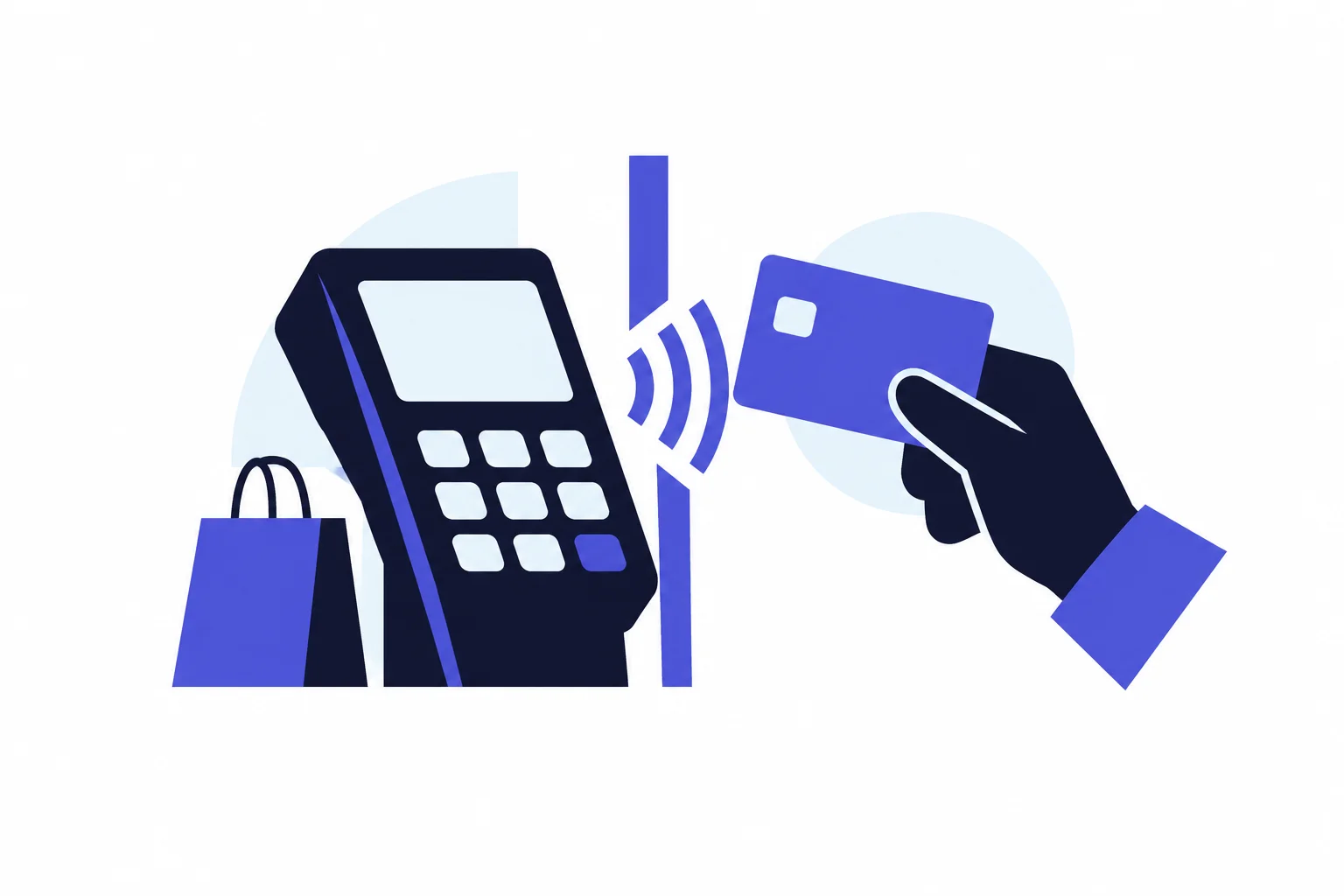
On July 28, 2026, Visa told investors that weekly tap-to-ride transit transactions in US World Cup host cities grew by nearly 40% year over year at their peak, after reporting in January that nearly 70% of its US in-person transactions are now taps. Tapping is now the default, but the US has no single tap limit like the old £100 cap in the UK. When a tap is declined, or you're asked to insert your card or enter a PIN, the reason is your bank's own rules, the store's terminal settings or the type of card, not a national limit.
Key takeaways
- No US law sets a tap limit, and Visa's US guidance tells terminals to switch off any "contactless transaction limit".
- Since 2020, Visa has let US merchants accept a tap, dip or swipe at a staffed checkout with no signature or PIN at any amount. Any prompt there is the merchant's or issuer's choice. Unattended machines such as kiosks follow separate limits.
- Under Visa's US guidance, every tap is sent to your bank for approval, so the bank's risk checks can decline any amount.
- A phone or watch wallet verifies you on the device, which is why a phone can sometimes pay where the plastic card hits a limit.
- OMNY in New York caps subway and local bus fares at $35 per 7 days, but only if you tap with the same card or device every time. A phone and a physical card count separately.
What it means for you
- Tapping a card at US stores: no published dollar ceiling applies. Prompts come from the store's terminal or your bank.
- Paying with a phone or watch: the device verifies you, so card-tap limits matter less. Transit modes skip that check.
- Your tap was declined: insert the card, follow the prompts, and ask your bank if it keeps happening. The $120 example below shows why.
- Riding transit: use one card or device for every ride to reach the fare cap.
- Running a small shop: under Visa's rules, the main tap-related setting you control is your terminal's verification limit.
- Traveling abroad: the EU, the UK and Canada work differently; see the country table.
Why the US has no single tap cap
Three separate settings decide whether a tap goes through without extra steps. Visa explained the difference in a 2018 EMV newsletter for US merchants and processors:
- Contactless transaction limit, the amount above which a reader refuses a tap altogether. Visa says this limit is "not supported in the U.S. or globally" and tells US terminals to disable it or set it to the maximum.
- Floor limit, the amount above which the reader must ask the card issuer for approval. Visa's US requirement is zero, so every tap goes online to your bank.
- Cardholder verification method (CVM) limit, the amount above which the terminal may ask for verification such as a PIN. Visa's US recommendation is to set it to zero on terminals using its "Quick Chip" software. Merchants without it may set a limit of their own.
Signature rules changed too. Visa made signatures optional for EMV-enabled US and Canadian merchants from April 14, 2018, for any amount, and left PIN rules unchanged. A Visa notice dated August 6, 2020 then said that in the US, all face-to-face transactions can use "no CVM" at any amount, by tap, dip or swipe, and that the old CVM limits no longer apply. The same notice kept Visa's separate limits for unattended transactions, such as self-service kiosks, where a magnetic-stripe payment above the limit needs a PIN or a phone's own verification. Mastercard and other networks publish their own rules, not covered here.
Banks can still set limits of their own. Chase's US page on contactless credit cards says tap payments "may have a transaction limit, which can vary," and that larger purchases may need the chip. It gives no dollar figure, so ask your bank.
What merchants control
For a small merchant, the main setting under Visa's guidance is the terminal's CVM limit. Leave it at zero and taps go through without a prompt. Set a figure and taps above it ask for verification. Visa's 2018 flyer also lets merchants prompt for a PIN on US debit and prepaid cards, as long as the customer can still pay without one. Visa's January 29, 2026 earnings call, source of the nearly 70% US figure, said "tap to phone" acceptance, which turns an ordinary phone into a card reader, has helped lift Visa acceptance to more than 175 million locations worldwide.
Why a tap turns into insert or PIN
Because every US tap goes to your bank in real time, a decline or "insert card" message can have several causes:
- The terminal's own limit. The merchant has set a CVM limit, and your purchase is above it.
- The issuer's risk rules. Your bank may cap single taps or the running total of taps, or flag a purchase that doesn't fit your usual spending.
- A debit PIN preference. Some merchants ask debit cardholders for a PIN, as Visa's rules allow.
- Counters on foreign cards. EU law limits how many taps, or how much in taps, an EU-issued card can make before the bank must check it's you (see the country table). A traveler's card from there may ask for a PIN in a US store.
Illustrative example: a $120 grocery tap
Hypothetical settings, not those of any real store or bank.
- Terminal rule: the grocer's terminal has a $100 CVM limit. $120 is $20 over it, so the screen asks for a PIN or for the card to be inserted.
- Issuer rule: the bank caps contactless spending at $500 a day, and the cardholder has already tapped $410. $410 + $120 = $530, which is $30 over the cap, so the bank declines the tap. Inserting the card and entering the PIN may then complete it.
- Neither rule applies: with a $0 CVM limit and no issuer cap in play, the same $120 tap goes through with no prompt.
In the first two cases the shopper sees a similar "insert card" or PIN prompt for different reasons: the first comes from the store's terminal before the bank is involved, the second from the bank's decline. The store can tell you about its terminal setting, but only the bank can tell you whether its own cap was hit.
If a card you tap with is lost
Tapping doesn't change your federal protections. For a lost or stolen debit card, Regulation E caps your liability at $50 if you tell the bank within two business days of learning about it. After that you can owe up to $500 in total: up to $50 for the first two business days, plus any later transfers the bank shows a timely report would have stopped. Unauthorized transfers not reported within 60 days of the statement showing them can leave you liable for later ones a timely report would have stopped, though banks must extend deadlines for reasons such as extended travel or a hospital stay. For credit cards, Regulation Z limits unauthorized-use liability to $50 or the amount charged before you notify the issuer, whichever is less, and the issuer can hold you liable at all only if it has told you about that liability and how to report a loss. This is general information, not legal advice for a specific dispute.
How phone and watch taps differ
A phone wallet checks who you are before it pays. Visa's 2020 notice calls this a "consumer device cardholder verification method", or CDCVM. Apple's Apple Pay instructions say an iPhone may ask for Face ID or the passcode before you tap in a store. Google's Wallet help page says a screen lock is required to pay. If you verified in the last few minutes, you may not be asked again.
Because the device has already checked you, some banks in countries with card-tap limits don't apply those limits to phone payments. For example, Chase's UK limits page lists £100 per card tap and £300 across several taps, and points customers to Apple Wallet or Google Wallet for contactless payments "without spending limits". That's a UK product. US issuers may or may not treat phones differently.
Transit is the main exception to the device check. With Apple's Express Mode, a chosen transit or payment card works without waking or unlocking the iPhone. Google Wallet has a setting that drops the screen-lock check for transit fares only, though Google notes that some transit systems don't support it. The trade-off: a lost phone can pay fares without being unlocked.
Tap-to-ride and fare caps
As of October 2026, MTA fares are $3 for most subway and local bus rides. Under OMNY tap and ride, you pay no more than $35 in a 7-day period that starts with your first tap. The cap is $67 if your rides include express buses, and $17.50 at the reduced fare. You can't buy or refill a MetroCard since January 1, 2026, so tapping is now the main way to pay.
The catch is in OMNY's fare cap rules. Each card, each card in a phone wallet and each joint card counts as a separate payment method with its own cap. Even if your debit card is also in your phone, the phone starts its own cap. Free transfers don't count toward the cap.
Weekly cost = min(paid rides × fare, cap)   (per card or device)
fare = $3.00, cap = $35.00 (OMNY, 7 days, subway and local bus)
Illustrative example: a commuter takes 14 paid rides in a week. On one card, 11 rides cost 11 × $3 = $33, the cap is reached on the 12th ride, and the week costs $35. Split as 7 rides on the plastic card and 7 on the phone, each side costs 7 × $3 = $21, neither reaches $35, and the week costs $42. Mixing devices costs $7 more.
The Bay Area is newer to this. The next-generation Clipper system began taking contactless credit and debit cards on Muni, Caltrain, Golden Gate Transit, VTA and other agencies on December 10, 2025. BART started in August 2025. The SFCTA's announcement describes transfer discounts of up to $2.85 off later rides within two hours, not an OMNY-style weekly cap.
Tap limits abroad, by country
Foreign fees and currency conversion are a separate question. The limits below apply to cards issued in each place. A US-issued card follows its US bank's rules, though a foreign merchant's terminal may still ask for a PIN, so know yours before you travel.
| Place | Tap limit before verification | Who sets it |
|---|---|---|
| United States | No national limit. Visa allows "no CVM" at any amount at staffed checkouts | Issuers and merchant terminals |
| European Union | At most €50 per tap, plus either €150 in total taps or 5 taps in a row since the last PIN. Banks may set lower limits | EU law: Regulation 2018/389, Article 11 |
| United Kingdom | No fixed regulatory limit since March 19, 2026. Banks set their own, based on risk. The old caps were £100 per tap and £300 cumulative or 5 taps | Banks, under FCA rules announced December 19, 2025 |
| Canada (Interac debit) | Up to C$250 per tap, plus a cumulative limit | Per-tap ceiling published by Interac. Each bank or credit union sets the cumulative limit |
In the UK, the FCA's Handbook Notice 136 says the FCA expects most banks to keep their existing limits in the short term. In the EU, the counts run from the last time the cardholder was verified, for example with a PIN. The European Banking Authority says only completed transactions need to count toward the totals, though a bank may count more.
Frequently asked questions
Can someone charge my card by holding a reader near my pocket?
Chase says a contactless card typically must be within 1 to 2 inches of the terminal, and that each transaction carries a one-time encrypted code. Chase still suggests checking statements regularly. If a charge isn't yours, the Regulation E and Z limits described above apply.
Will Apple Pay work if my iPhone battery dies?
Only for cards set up with Express Mode. Apple says power reserve lets some Express Mode cards, passes and keys work for up to five hours after the iPhone needs charging. It doesn't work if the phone has been turned off. Regular Apple Pay purchases that need Face ID or a passcode won't work on a dead phone.
Do I still have to sign receipts?
Usually not. Visa made signatures optional at EMV-enabled US merchants from April 14, 2018, and for all merchants worldwide in May 2020, unless local law requires one. A merchant can still ask you to sign to accept extra terms of a sale, such as a limited refund policy or a tip.
Why does my debit card sometimes ask for a PIN when my credit card doesn't?
Visa's rules let US merchants prompt for a PIN on debit and prepaid cards, as long as there's another way to pay without one. Merchants can also send domestic debit transactions over any network the issuer has enabled on the card, whatever the verification method. A PIN prompt on debit often reflects the merchant's preferred network, not a spending limit.
Can one OMNY tap pay for friends?
Yes. OMNY lets you pay for up to three more riders with the same card or device. Only your own first tap counts toward the 7-day cap, and the extra taps are charged the full fare. The exception is a card or device's first ride: the MTA says your bank must approve it before you can pay for others, which generally takes only a few minutes.
A quick check before your next tap
- Open your bank's app or call the issuer and ask whether your card has a per-tap or daily contactless limit. Ask the same about the cards in your phone.
- Make sure you know your debit card PIN. It's the fallback when a tap asks for verification, at home and abroad.
- Choose one card or device for transit and use it every time, so the rides count toward one fare cap.
- If you turn on Express Mode or skip transit verification, remember that your phone can then pay fares without being unlocked.
- Turn on purchase alerts so you see every tap, and report a lost card or phone within two business days.
Sources
- Visa, fiscal Q1 2026 earnings call transcript, January 29, 2026
- Visa, fiscal Q3 2026 earnings call transcript, July 28, 2026
- Visa, EMV News, December 2018: US Visa contactless limits
- Visa, Signature optional (US and Canada), April 2018
- Visa, Changes to Visa Easy Payment Service, August 6, 2020
- Chase (US), What is a contactless credit card
- Chase UK, Contactless card transaction limits
- CFPB, Regulation E, 12 CFR 1005.6
- CFPB, Regulation Z, 12 CFR 1026.12
- Apple Support, How to use Apple Pay
- Apple Support, Use Express Mode in Apple Wallet
- Google Wallet Help, Verify it's you to make a purchase
- MTA, Subway and bus fares
- MTA, Tap and ride
- MTA, MetroCard
- OMNY, Fare cap FAQ
- San Francisco County Transportation Authority, Next-generation Clipper, December 12, 2025
- Commission Delegated Regulation (EU) 2018/389, Article 11
- European Banking Authority, Q&A 2018_4230
- FCA, Greater flexibility for future contactless limits, December 19, 2025
- FCA, Handbook Notice 136, December 2025
- Interac, Interac Debit FAQ